

Clear records
history record
6 Channel Vehicle Camera System with ADAS for Smarter Fleet Operations
Modern commercial vehicles operate in an environment where safety expectations, operational efficiency, and regulatory pressure are all rising at the same time. A 6 channel vehicle camera system is no longer an optional add-on—it has become a core operational tool for fleets that want measurable risk reduction and better driver control. In this blog post, Shenzhen HOPE, as high quality commercial vehicle 360 camera system exporter, will share the 6 channel vehicle camera system with ADAS for smarter fleet operations.
Why 6 Channel Vehicle Camera System with ADAS Fits Real-World Driving Complexity
Commercial vehicles rarely face a single-direction risk. Blind spots, lateral movement, reversing, and night driving all occur simultaneously. A six-channel architecture allows continuous visual coverage from multiple angles at once, aligning with how vehicles are actually driven rather than how they are theoretically designed.
In practice, operators value the ability to see front, rear, both sides, and additional critical areas at the same time. This multi-angle visibility significantly reduces cognitive load on drivers, especially in congested urban delivery routes or long-haul night operations. When combined with ADAS voice alerts, the system moves from passive recording to active risk intervention.
Deploying Multi-View Monitoring Without Overloading the Driver
One overlooked challenge in vehicle monitoring is information overload. A 6 channel vehicle camera system with ADAS works best when screen layout, split-screen logic, and alert priority are carefully balanced.
Split-screen display enables drivers to maintain situational awareness without constantly switching views. Loop recording ensures that continuous monitoring does not require manual intervention, which is essential for long shifts. From operational experience, systems that automatically overwrite older footage reduce driver distraction and simplify daily workflows.
The key is that all six channels work in parallel, not competition. The driver sees what matters at the moment, while the system quietly records everything else in the background.
Integrating Smart ADAS Alerts into Daily Driving Behavior
ADAS functionality delivers the most value when alerts are timely, accurate, and limited to meaningful events. Forward collision warnings, lane departure alerts, pedestrian collision detection, and front vehicle start notifications act as a second layer of awareness rather than a constant alarm source.
In a 6 channel vehicle camera system with ADAS, voice alerts are particularly effective because they do not require visual attention. Experienced fleets tune alert sensitivity to match vehicle size, load condition, and typical driving environments, ensuring the system supports rather than frustrates drivers.
Over time, drivers tend to adapt their behavior naturally, relying less on mirrors alone and more on coordinated visual and audio feedback.
Blind Spot Detection as Complement, Not a Replacement
Blind spot detection algorithms play a crucial role, but they are most effective when paired with camera-based visibility. BSD monitors areas that mirrors cannot reliably cover, especially alongside large commercial vehicles and at cargo corners.
Within a six-camera configuration, BSD functions as a confirmation layer. When visual input and audible warnings align, driver reaction time improves noticeably. This combination is especially valuable during lane changes, urban turns, and low-speed maneuvers where accidents typically occur despite low driving speeds.
Night Vision and Weather Resistance in Continuous Operation
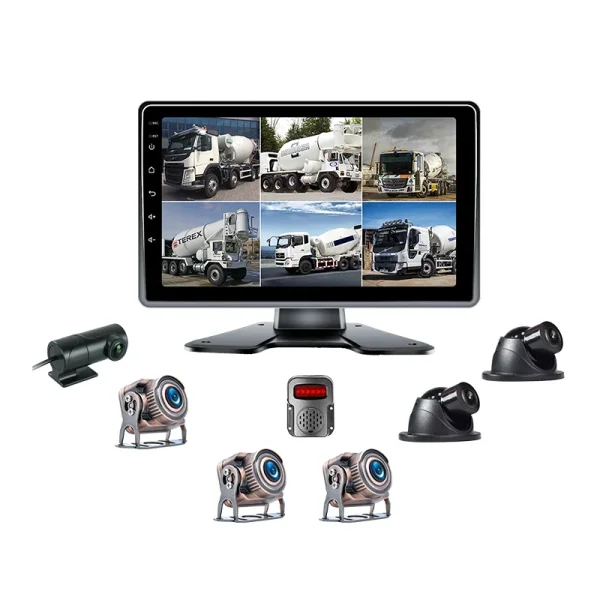
Real operational value comes from reliability in poor conditions. Night driving, rain, dust, and temperature extremes quickly expose weak hardware. IP68 waterproof cameras with starlight night vision maintain image clarity without constant recalibration or replacement.
From long-term usage experience, metal-housed cameras with adjustable lenses reduce maintenance frequency and ensure consistent viewing angles despite vibration. In a 6 channel vehicle camera system with ADAS, consistency across all channels matters more than ultra-high resolution on a single camera.
Touchscreen Interaction That Reduces Training Time
A 10.1-inch full touch IPS display offers a balance between visibility and dashboard integration. Touch interaction simplifies camera switching, playback, and configuration without adding external controls.
For fleet operators, shorter training cycles translate directly into faster deployment. Drivers familiar with smartphone-style interfaces adapt quickly, making the system easier to standardize across different vehicle models.
Parking assist functionality, including reverse view and dynamic guidelines, becomes especially useful for larger vehicles where rear visibility is structurally limited.
Data Recording That Supports Accountability Without Micromanagement
Loop recording and multi-channel video storage serve multiple purposes: incident review, driver coaching, and compliance support. Importantly, effective systems operate autonomously, without requiring drivers to manage storage manually.
A well-configured 6 channel vehicle camera system with ADAS captures objective driving data while allowing managers to focus on trends rather than isolated events. This supports a culture of improvement rather than constant surveillance.
Scaling Across Fleets with Different Operating Profiles
One advantage of modular six-channel systems is scalability. Vehicles with different risk profiles—urban delivery, highway transport, mixed-use fleets—can enable or prioritize different channels and ADAS features without changing core hardware.
This flexibility reduces long-term costs and simplifies spare parts management, even though pricing itself is not the primary consideration for safety-driven deployments.
Long-Term Operational Value Beyond Compliance
While regulatory compliance often triggers initial adoption, long-term value comes from reduced incident frequency, improved driver confidence, and smoother daily operations. A 6 channel vehicle camera system with ADAS contributes to all three when integrated thoughtfully rather than installed as a checkbox solution.
The most successful deployments treat the system as part of the driving environment, not an external monitoring tool.
Final Thoughts
Experience shows that effectiveness depends less on headline specifications and more on how well the system aligns with real driving behavior. Balanced camera placement, intelligent ADAS alerts, durable night-capable hardware, and intuitive interaction define a system that drivers actually trust.
When implemented with a clear operational mindset, a 6 channel vehicle camera system with ADAS becomes a practical safety partner—one that quietly supports every kilometer driven, day or night.