

Clear records
history record
Bus and Truck 360 Camera System for Fleet Management and Insurance Compliance
Fleet operators today face growing pressure from safety regulations, rising insurance premiums, accident liability disputes, and increasing urban traffic complexity. In this environment, a bus and truck 360 camera system is no longer just a driver assistance tool — it has become a core component of fleet risk management and compliance strategy. In this blog post, Shenzhen HOPE, as high performance vehicle camera system manufacturer, will share the advantages of bus and truck commercial vehicle 360 camera system for fleet management.
Why Fleet Operators Are Turning to 360 Degree Camera Systems
Urban delivery trucks, long-haul semi trucks, school buses, and public transit vehicles all share one structural limitation: blind spots. Traditional side mirrors and rear cameras cannot fully eliminate risk areas around large commercial vehicles.
A 360 degree bird view camera system for buses and trucks stitches images from multiple ultra-wide cameras into a seamless panoramic view, creating a top-down perspective of the vehicle and its surroundings. This dramatically improves:
Blind spot monitoring
Low-speed maneuvering safety
Parking precision
Pedestrian and cyclist detection
Docking and yard operations
For fleet managers, reducing minor collision frequency directly lowers repair costs and downtime. For insurers, fewer blind-spot-related accidents translate into improved risk profiles and more favorable premium negotiations.
AR Surround View Technology Designed for Commercial Vehicles
Modern systems go beyond simple stitched images. A next-generation AR 360 around view camera system integrates a dynamic wireframe vehicle model that does not block the driver’s field of view. This design is especially suitable for buses and heavy-duty trucks where cabin height and body length demand precise spatial awareness.
Unlike older surround view solutions originally designed for passenger cars, commercial-grade systems offer:
Multiple channel viewing modes
Split-screen monitoring
Real-time DVR recording
Custom overlays for vehicle dimensions
Industrial-grade vibration resistance
For fleet deployment, the difference between automotive-grade and commercial-grade 360 camera systems is critical. Heavy-duty trucks operate under extreme vibration, long duty cycles, and varying weather conditions. Hardware durability directly impacts long-term ROI.
Remote Calibration Reduces Installation Downtime
One of the biggest barriers to large-scale fleet rollout has historically been calibration complexity. Traditional surround view systems require large calibration mats and multiple technicians.
A new generation remote calibration 360 camera system solves this issue. With seamless splicing technology, installation can be completed in approximately 10 minutes without specialized ground cloths or additional personnel.
For fleet managers overseeing hundreds of buses or trucks, this translates into:
Reduced vehicle downtime
Lower installation cost per unit
Faster deployment across regional fleets
Minimal disruption to operations
From a business perspective, scalability is just as important as performance.
Android OS Car DVR as the Operational Core
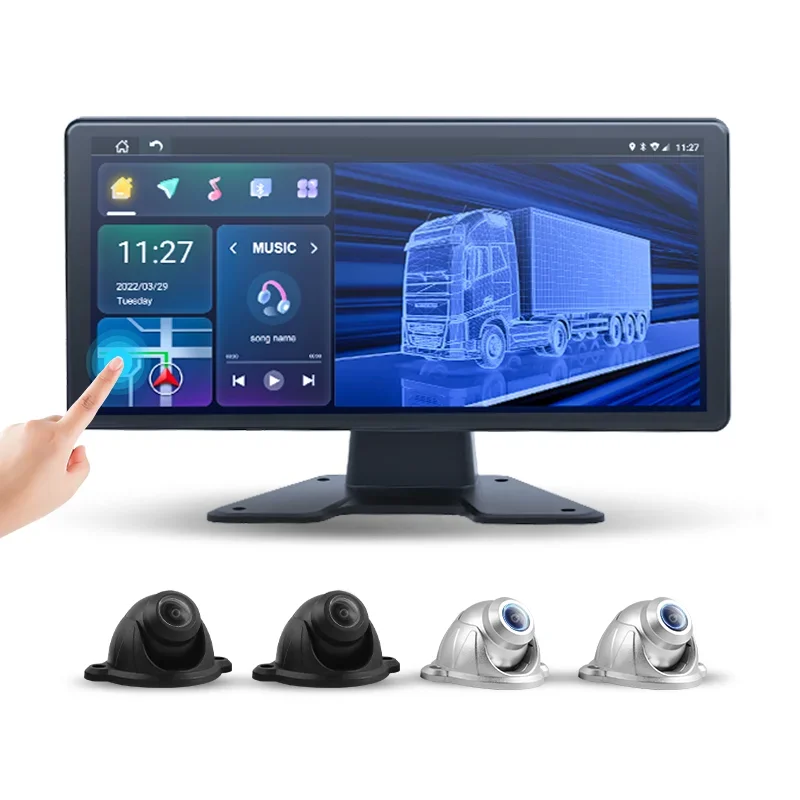
A 10.36-inch Android OS car DVR integrated into the bus and truck 360 camera system provides more than visual monitoring. It becomes a central operational interface inside the vehicle.
Key features typically include:
High-definition video recording
Multi-channel playback
USB hard drive support
Automatic video detection and playback
Touchscreen control
Bluetooth music and hands-free calling
For fleet operations, the Android-based interface allows easier system upgrades, firmware updates, and application integration compared to closed proprietary systems.
GPS Tracking and 4G Connectivity for Fleet Visibility
A 4G GPS 360 camera system for commercial vehicles extends value beyond the driver’s cabin. With real-time connectivity, fleet supervisors can log into a cloud platform via computer or mobile app to access:
Live vehicle positioning
Route playback history
Remote camera recording
Driving behavior monitoring
Incident evidence storage
This integration of surround view imaging with telematics is especially important for:
Public transportation fleets
Logistics companies
School bus operators
Construction vehicle fleets
In the event of an accident, recorded road conditions and driver behavior can provide essential evidence for insurance claims and liability clarification.
Insurance Compliance and Risk Mitigation Strategy
Insurance providers increasingly evaluate fleet risk based on data transparency and safety technologies. Installing a bus and truck surround view camera system with DVR recording strengthens a fleet’s compliance profile in several ways:
Provides objective accident evidence
Reduces fraudulent claims
Demonstrates proactive safety investment
Supports driver training programs
Documents adherence to safety policies
Some insurers offer premium reductions when fleets deploy advanced driver monitoring and multi-camera systems. Even when discounts are not immediate, strong documentation reduces dispute duration and legal exposure.
Driver Behavior Monitoring and Accountability
A connected commercial vehicle 360 degree camera DVR system also improves internal fleet discipline. When drivers know their routes and surroundings are recorded, unsafe behaviors such as harsh turns, improper lane positioning, or distracted driving decrease significantly.
Remote recording capability allows fleet managers to review:
Risky intersections
Delivery site maneuvering
Congested urban operations
School bus stop safety compliance
Over time, this data supports targeted driver coaching and measurable safety improvement programs.
Integration with Blind Spot Detection and ADAS
While a 360 camera system provides visual awareness, combining it with blind spot detection (BSD) sensors and ADAS functions creates a layered safety architecture.
Commercial vehicle surround view systems can integrate with:
Lane departure warning
Pedestrian detection
Collision alert
Reverse parking assist
Turn signal-triggered side views
For heavy-duty trucks operating in dense urban environments, layered technology significantly reduces vulnerability during turning and lane merging.
Data Storage and Evidence Management
Systems equipped with hard drive or USB storage automatically detect and organize video files. This simplifies evidence retrieval after incidents.
A well-implemented fleet 360 camera system with cloud platform should include:
Encrypted storage
Event-triggered recording
Cloud backup options
Time-stamped GPS tagging
Multi-vehicle centralized management
Without proper data organization, video evidence becomes difficult to manage across large fleets. Structured storage is therefore essential for insurance compliance and operational transparency.
Cost-Benefit Analysis for Fleet Decision Makers
From a procurement perspective, evaluating a bus and truck 360 camera system requires more than comparing hardware price. Decision-makers should assess:
Installation scalability
Calibration time
System durability
Cloud subscription model
Data storage capacity
Insurance premium impact
Accident reduction potential
A lower upfront hardware cost may lead to higher long-term maintenance expenses. Fleet-wide deployment demands reliability, especially for cross-border logistics or national bus networks.
Deployment Scenarios Across Industries
Commercial vehicle surround view camera systems are widely applied in:
Urban delivery trucks
Long-haul tractor trailers
School buses
Public transit buses
Garbage trucks
Construction dump trucks
Mining transport vehicles
Each sector has distinct compliance requirements, but all benefit from panoramic visibility and centralized monitoring.
Future Outlook for Fleet Safety Technology
The evolution of the bus and truck 360 camera system is moving toward deeper integration with AI analytics, cloud-based risk scoring, and predictive safety modeling. Future systems will likely combine:
AI pedestrian recognition
Real-time driver fatigue detection
Fleet-wide safety dashboards
Insurance telematics scoring
Automated compliance reporting
For fleet operators preparing for stricter safety regulations and ESG reporting requirements, investing early in scalable 360 degree camera technology positions them ahead of regulatory changes.
Final Perspective
A bus and truck 360 camera system for fleet management and insurance compliance is not simply an optional accessory. It is an operational tool that connects driver visibility, risk reduction, telematics integration, and liability documentation into one unified solution.
When implemented correctly — with remote calibration, AR surround view, Android DVR integration, GPS tracking, 4G connectivity, and structured cloud management — it transforms how fleets manage safety, accountability, and insurance relationships.
For fleet managers seeking long-term cost control and competitive advantage, surround view technology has shifted from innovation to infrastructure.