

Clear records
history record
Commercial Vehicle 360 Camera System for Heavy Duty Vehicles
Why Commercial Vehicle 360 Camera System Matters for Heavy Duty Vehicles
Heavy-duty vehicles operate in some of the most demanding environments on the road. Whether managing long-haul trucks, construction fleets, mining vehicles, buses, or municipal service vehicles, operators face a constant challenge: maintaining complete situational awareness around large vehicles with significant blind spots. Traditional mirrors and standard reversing cameras can only provide limited visibility, leaving critical areas vulnerable to accidents, property damage, and operational delays.
This is exactly where a Commercial Vehicle 360 Camera System becomes an essential technology investment rather than just an optional upgrade. By integrating panoramic imaging, intelligent recording, remote monitoring, and real-time driver assistance, modern 360-degree systems are transforming how fleet managers approach safety, efficiency, and risk reduction.
For heavy-duty vehicle operators, selecting the right system requires more than simply comparing camera resolution. It involves understanding installation efficiency, panoramic stitching quality, remote calibration capabilities, night vision performance, telematics integration, and long-term fleet scalability.
In this blog post, Shenzhen HOPE, as high performance dash cam with adas and gps exporter, will share the role of commercial vehicle 360 camera system for heavy duty vehicles.
The Visibility Problem in Heavy Duty Vehicle Operations
Heavy-duty vehicles naturally create operational blind zones due to their size and structure.
Common blind spot risks include:
Front bumper low-angle zones
Side turning blind spots
Rear reversing hazards
Trailer connection visibility gaps
Pedestrian and cyclist proximity risks
Warehouse and loading dock maneuvering limitations
For trucks, buses, and industrial vehicles, even a minor visibility error can result in:
costly repairs,
insurance claims,
vehicle downtime,
legal liability,
reduced driver confidence.
A commercial truck 360 camera system directly addresses these limitations by creating a full bird’s-eye digital view around the vehicle.
How a Commercial Vehicle 360 Camera System Works
A 360 surround view camera system for trucks typically uses four ultra-wide-angle cameras installed around the vehicle:
Front camera
Rear camera
Left side camera
Right side camera
These cameras capture simultaneous real-time video.
Advanced software then performs:
lens correction,
image alignment,
seamless stitching,
perspective transformation.
The result is a complete panoramic top-down image displayed on the main screen.
Drivers can instantly understand surrounding obstacles without relying only on mirrors.
Modern systems also support:
split-screen monitoring,
multi-angle switching,
triggered side-view display,
reversing priority views.
Why Heavy Duty Vehicles Need Specialized 360 Camera Technology
Passenger vehicle camera systems are not built for commercial applications.
Heavy-duty environments demand:
Wide Voltage Compatibility
Commercial fleets often operate on 12V, 24V, or 36V systems.
A professional-grade system supports 9V–36V wide voltage, ensuring compatibility across:
trucks,
buses,
trailers,
engineering machinery,
specialty vehicles.
Rugged Waterproof Cameras
Commercial vehicles operate through:
rain,
dust,
mud,
snow,
vibration.
Industrial-grade IP-rated waterproof cameras provide durability for long-term outdoor use.
Night Vision Performance
Heavy-duty fleets often run overnight.
Starlight night vision cameras improve visibility in:
low-light roads,
underground loading zones,
warehouse yards,
nighttime logistics routes.
This dramatically improves safety after dark.
The Advantage of Seamless Circular Stitching
Not all panoramic systems produce clean images.
Poor systems often suffer from:
visible stitching lines,
image distortion,
delayed transitions,
inaccurate obstacle positioning.
A premium Commercial Vehicle 360 Camera System uses seamless circular stitching to create:
natural overhead viewing,
accurate object placement,
better driver trust,
reduced cognitive load.
This becomes especially important during:
tight urban turns,
loading dock alignment,
trailer maneuvering,
parking in narrow industrial spaces.
Fast Installation Reduces Fleet Downtime
For commercial operators, installation time matters.
Traditional multi-camera systems can require:
long wiring procedures,
manual calibration cloths,
multiple technicians,
extended vehicle downtime.
Modern heavy-duty solutions simplify deployment.
Benefits include:
installation in approximately 15 minutes,
aviation-grade plug interfaces,
simplified wiring architecture,
lower labor cost,
faster fleet-wide rollout.
This makes scaling across large fleets much more practical.
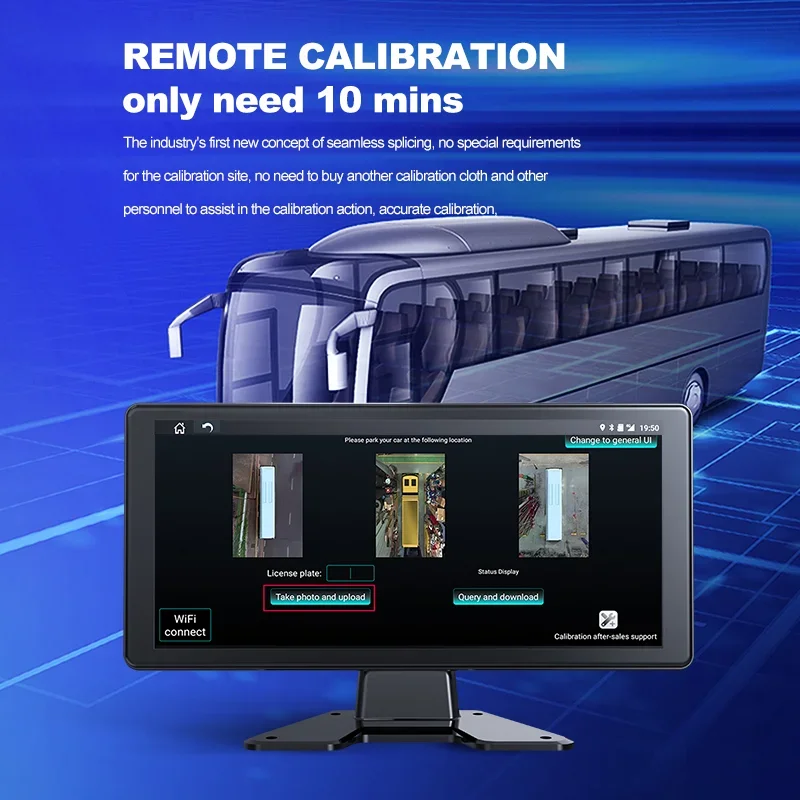
Remote Calibration Changes the Industry Standard
Calibration used to be one of the biggest barriers.
Traditional calibration required:
special printed mats,
precise positioning,
multiple staff members,
long setup times.
New remote calibration technology changes this completely.
Now fleets can achieve:
calibration in about 10 minutes,
no special site preparation,
reduced technician dependency,
accurate panoramic alignment.
For service teams managing hundreds of vehicles, this is a major operational advantage.
AR Around View Improves Driver Decision Making
One of the most innovative upgrades in modern systems is AR 360 around view technology.
Instead of displaying only camera footage, AR overlays:
dynamic guide lines,
vehicle wireframes,
directional movement prediction,
obstacle awareness references.
For heavy-duty vehicles, this matters because large vehicle bodies can obstruct visibility.
A transparent wireframe model gives drivers:
better turning judgment,
safer reversing,
improved trailer positioning,
clearer narrow-road navigation.
This improves both safety and confidence.
Android-Based Smart Displays Add Operational Value
A modern system should be more than a camera monitor.
An Android-based commercial display turns the unit into a central vehicle management platform.
Features often include:
10.36-inch IPS touch display,
responsive touch controls,
voice commands,
trigger-based camera switching,
customizable interface.
This reduces dashboard clutter because operators no longer need separate devices.
GPS Integration Supports Fleet Intelligence
Location tracking is now expected in commercial transportation.
Built-in GPS supports:
live vehicle positioning,
route playback,
dispatch visibility,
route optimization.
For fleet managers, this improves:
delivery accuracy,
fuel efficiency,
asset security.
Combined with video recording, GPS also creates stronger event evidence.
4G Connectivity Enables Remote Monitoring
Remote fleet visibility is increasingly important.
With 4G support, managers can access:
live camera feeds,
vehicle location,
remote recording,
status monitoring.
Benefits include:
immediate accident verification,
driver behavior oversight,
reduced response time,
stronger fleet accountability.
For large logistics companies, this dramatically improves operational control.
Multi-Network Compatibility Improves Reliability
Heavy-duty fleets often travel across regions.
Systems supporting:
4G,
WiFi,
AGPS,
Beidou,
GLONASS,
deliver more reliable connectivity and location accuracy.
This matters especially for:
cross-border transport,
remote construction zones,
long-distance freight routes.
DVR Recording Protects Fleet Liability
Continuous loop recording remains one of the most valuable features.
A professional commercial vehicle dash camera with 360 view records:
road conditions,
driver actions,
external incidents,
unexpected collisions.
Benefits include:
insurance evidence,
legal defense,
driver training,
fraud prevention.
With support for large TF cards and SSD storage, fleets gain extended recording capacity.
Voice Control Supports Safer Driving
Touchscreens are useful—but hands-free control is safer.
Voice commands allow drivers to:
switch views,
start recording,
access navigation,
manage settings.
This reduces distraction and supports compliance with safety policies.
Bluetooth Adds Driver Convenience
While often overlooked, Bluetooth integration improves driver usability.
Drivers can:
answer calls,
sync contacts,
stream music,
manage media playback.
Reducing device handling helps improve road safety.
Navigation Built Into the Same System
Instead of installing separate navigation hardware, an Android platform enables:
online maps,
real-time traffic,
route guidance,
dynamic rerouting.
For fleet operators, this lowers equipment cost while simplifying the cabin environment.
Commercial Applications Across Industries
A Commercial Vehicle 360 Camera System is valuable across many sectors.
Logistics Fleets
Ideal for:
delivery trucks,
freight vehicles,
last-mile fleets.
Benefits:
safer urban driving
fewer claims
Public Transportation
Perfect for:
buses,
school transportation,
airport shuttles.
Benefits:
passenger safety
blind spot reduction
Construction Vehicles
Useful for:
dump trucks,
cranes,
cement mixers.
Benefits:
safer site movement
obstacle awareness
Mining and Industrial Equipment
Critical for:
loaders,
haulers,
heavy machinery.
Benefits:
harsh environment durability
accident prevention
Municipal Fleets
Supports:
garbage trucks,
fire vehicles,
road service fleets.
Benefits:
narrow street navigation
public safety
Key Features Buyers Should Prioritize
When comparing systems, prioritize:
Camera Quality
Choose at least:
720P or higher
starlight night vision
Display Quality
Look for:
IPS panel
touch responsiveness
wide viewing angle
Storage Support
Important for long operation:
high-capacity TF cards
SSD compatibility
Operating Temperature
Heavy-duty equipment needs:
wide temperature tolerance
industrial reliability
Easy Installation
Look for:
aviation connectors
modular design
reduced downtime
Remote Platform Support
Cloud access should include:
web platform
mobile app
live monitoring
ROI Beyond Safety
A 360 degree camera system for commercial vehicles creates measurable business value.
Potential savings include:
reduced accident repair costs
lower insurance premiums
fewer legal disputes
less vehicle downtime
better driver retention
improved operational efficiency
The return often becomes visible much faster than expected.
The Future of Heavy Vehicle Vision Systems
The next generation of systems will increasingly include:
AI pedestrian alerts
driver fatigue detection
ADAS integration
cloud analytics
predictive maintenance support
The Commercial Vehicle 360 Camera System is becoming the foundation for smarter connected fleets.
Businesses that adopt early gain a clear operational advantage.
Final Thoughts
Heavy-duty vehicle safety can no longer rely on mirrors alone.
As fleets become larger, routes become more complex, and safety regulations become stricter, complete visibility becomes essential.
A modern Commercial Vehicle 360 Camera System delivers more than a panoramic image—it provides:
real-time awareness,
fleet intelligence,
accident prevention,
operational efficiency,
long-term cost savings.
For organizations operating trucks, buses, industrial vehicles, or specialized equipment, investing in the right surround-view solution is one of the smartest technology decisions available today.