

Clear records
history record
Night Vision Camera for Truck Monitoring System That Improves Safety on the Road
Modern commercial vehicles operate in increasingly complex environments. Trucks frequently travel at night, enter poorly lit loading zones, maneuver in tight urban streets, and reverse near pedestrians, equipment, or loading docks. In these situations, drivers rely heavily on visibility and situational awareness. A night vision camera for truck monitoring system plays a crucial role in solving these challenges by providing clear visual feedback regardless of lighting conditions.
Unlike traditional backup cameras designed only for occasional reversing, modern truck monitoring systems integrate high-resolution cameras, wide viewing angles, intelligent display monitors, and infrared night vision technology. Together, these features create a real-time safety system that helps drivers maintain control, reduce blind spots, and operate more efficiently in demanding environments.
In this blog post, Shenzhen HOPE, as high quality commercial vehicle tracking system manufacturer, will share its night vision camera for truck monitoring system that improves safety on the road, why it has become essential for modern fleets, and how businesses can select the right solution for long-term performance and safety.
Night Vision Camera for Truck Monitoring System in Real Driving Conditions
Commercial trucks operate in environments where lighting conditions constantly change. Night driving, dim warehouses, underground parking facilities, and poorly lit rural roads all create visibility limitations that mirrors alone cannot solve.
A night vision camera for truck monitoring system uses infrared illumination and sensitive image sensors to capture detailed images even in low-light or near-dark environments. Instead of relying solely on ambient lighting, infrared LEDs illuminate the scene, allowing the camera to detect obstacles, pedestrians, and nearby vehicles.
This capability is particularly valuable in several real-world scenarios:
• Reversing into dark loading docks
• Parking in poorly lit industrial zones
• Nighttime highway stops or service areas
• Rural deliveries with minimal street lighting
• Monitoring blind spots during nighttime lane changes
With a properly configured system, drivers gain clear visual information on the monitor, significantly reducing the risk of accidents caused by poor visibility.
How Infrared Night Vision Improves Truck Monitoring System Performance
Infrared technology is the core feature that differentiates a night vision truck camera system from conventional cameras. Instead of relying only on standard image capture, IR LEDs emit invisible infrared light that reflects off nearby objects and returns to the camera sensor.
This process allows the system to produce clear images even when human eyesight struggles to detect shapes in the dark.
Key benefits of infrared night vision include:
• Clear object detection in low light
Pedestrians, vehicles, and obstacles become visible even in near darkness.
• Stable monitoring performance at night
Image clarity remains consistent whether the truck is parked or moving.
• Improved safety during reversing
Drivers can accurately judge distances while backing up.
• Reduced dependence on external lighting
Even when street lights or warehouse lights are insufficient, the camera still functions effectively.
Because nighttime accidents often occur due to visibility limitations, infrared night vision technology dramatically improves driver awareness and operational safety.
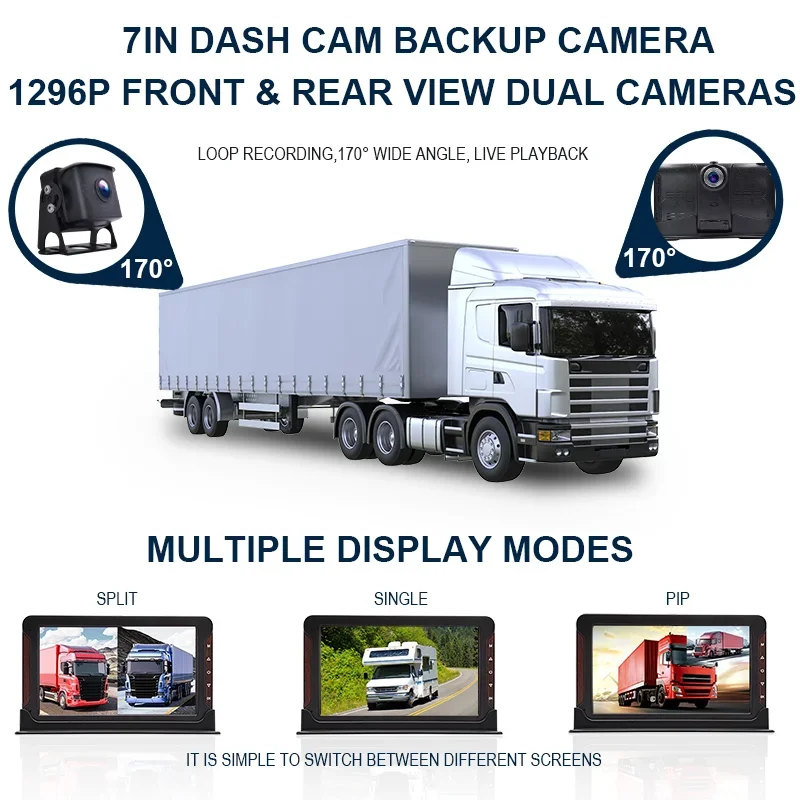
Wide Angle Non-Distortion Camera for Better Rear and Side Visibility
Field of view is another critical factor in a truck monitoring camera system. Cameras with narrow viewing angles cannot capture enough surrounding space, while extremely wide fisheye lenses distort the image and make it difficult for drivers to judge distance accurately.
A 150-degree wide viewing angle with non-fisheye distortion provides an optimal balance between coverage and image accuracy.
This configuration offers several practical advantages:
• Wider observation of blind spots
• Clearer spatial awareness when reversing
• Accurate distance judgment without image warping
• Better visibility for lane changes and tight turns
For trucks, buses, trailers, and commercial fleets, this wide-angle approach allows drivers to monitor surrounding conditions more effectively while maintaining realistic depth perception.
Why a 7 Inch IPS Monitor Improves Truck Camera System Usability
While camera quality is essential, the display monitor also plays a significant role in overall system performance. Many older truck camera systems rely on low-resolution LCD displays that struggle with brightness, contrast, or viewing angles.
A 7 inch IPS HD monitor provides several improvements that make monitoring easier for drivers:
Clearer Image Detail
High-definition resolution allows drivers to distinguish obstacles, curbs, pedestrians, or vehicles more easily.
Wider Viewing Angle
IPS technology maintains consistent color and brightness even when the driver views the screen from different angles.
Better Color Accuracy
Clear and vibrant color reproduction helps drivers quickly interpret the environment shown on the screen.
Reduced Eye Strain
Sharp images and stable brightness reduce visual fatigue during long driving hours.
For professional fleet operators, upgrading to an IPS monitor significantly improves the effectiveness of the night vision camera for truck monitoring system.
Anti Glare Sunshade Design for Daytime Monitoring
Truck monitoring systems must perform well not only at night but also during bright daytime conditions. Direct sunlight entering the cabin can cause screen glare, making the display difficult to see.
To solve this problem, many monitoring systems include an anti-glare sunshade around the monitor. This simple but effective feature improves visibility in several ways:
• Blocks direct sunlight from hitting the screen
• Reduces reflection and glare
• Maintains image clarity in bright environments
• Allows drivers to view the monitor quickly without distraction
By improving daytime usability, the system remains effective throughout the entire driving cycle, from daytime deliveries to nighttime operations.
Parking Guidelines and Image Flip for Easier Reversing
Reversing a truck or trailer requires precise spatial awareness. Even experienced drivers sometimes struggle to judge distance or alignment, especially in narrow spaces.
Modern truck monitoring systems with parking guidelines display reference lines on the screen that help drivers estimate distance and direction. These guidelines simplify complex reversing maneuvers.
In addition, image flip functionality allows the display to adjust the camera orientation depending on the installation position. Whether the camera is mounted at the rear, front, or side of the vehicle, the system can display the correct image orientation.
Key benefits include:
• Faster and safer reversing
• Reduced driver neck strain from constant turning
• Improved parking accuracy
• Lower risk of collisions with obstacles
For fleet operators, these features significantly reduce vehicle damage and operational downtime.
Multi Channel Truck Monitoring System for Complete Vehicle Coverage
Modern truck camera systems often support two-channel or multi-channel video inputs, allowing multiple cameras to connect to the same monitor.
A 2CH AHD monitoring system typically supports configurations such as:
• Rear camera for reversing
• Side camera for blind spot monitoring
• Front camera for parking assistance
• Cargo area camera for load monitoring
Drivers can switch between camera views or display them automatically when specific driving actions occur, such as activating reverse gear.
This multi-camera setup transforms the night vision camera for truck monitoring system into a complete vehicle safety solution.
Fleet Safety Benefits of Night Vision Camera Systems
For transportation companies and logistics fleets, safety improvements translate directly into operational savings and regulatory compliance.
A well-designed night vision truck monitoring system helps fleets achieve several safety objectives:
• Reduced reversing accidents
• Improved pedestrian detection
• Better lane change awareness
• Lower vehicle repair costs
• Enhanced driver confidence
Many fleet operators report fewer incidents and improved driver performance after installing camera monitoring systems across their vehicles.
Installation Considerations for Truck Camera Monitoring Systems
To achieve optimal performance, installation should be planned carefully. The positioning of cameras and monitors affects visibility and system reliability.
Important installation considerations include:
• Camera placement to eliminate blind spots
• Weatherproof housing for outdoor durability
• Stable power connection from vehicle electrical system
• Secure monitor mounting within driver sightline
• Proper cable routing to prevent signal interference
Professional installation ensures the night vision camera for truck monitoring system performs reliably in demanding commercial environments.
Future Development of Truck Monitoring Technology
As transportation technology continues to evolve, truck monitoring systems are becoming more intelligent and integrated with other safety technologies.
Future developments may include:
• AI-based pedestrian detection
• Collision warning alerts
• Wireless camera systems
• Cloud fleet monitoring platforms
• Integration with advanced driver assistance systems (ADAS)
These innovations will further strengthen the role of night vision camera systems as a core component of modern commercial vehicle safety infrastructure.
Final Thoughts on Choosing a Night Vision Camera for Truck Monitoring System
For trucks operating in complex and often unpredictable environments, visibility is one of the most critical factors affecting safety and efficiency. A night vision camera for truck monitoring system provides drivers with a clear view of surrounding conditions regardless of lighting challenges.
Features such as infrared night vision, wide-angle non-distortion cameras, IPS HD monitors, parking guidelines, and multi-channel monitoring create a comprehensive safety solution for both individual drivers and large fleet operators.
As logistics, construction, and transportation industries continue to demand higher safety standards, investing in a high-quality truck monitoring system is no longer optional. It is a practical step toward reducing accidents, improving driver awareness, and ensuring smoother vehicle operations day and night.