

Clear records
history record
Smart 4 Channel Dash Camera System for Safer Connected Fleet
A modern fleet is no longer judged solely by vehicle quality—it is judged by how intelligently it operates. As commercial transportation companies, ride-share drivers, and corporate fleets prioritize safety, transparency, and real-time data, the dual dash camera system emerges as a transformative solution. Far beyond simple video recording, today’s multi-camera platforms integrate AI algorithms, cloud networking, driver monitoring, and comprehensive analytics to build a smarter mobility ecosystem. In this blog post, Shenzhen HOPE, as high performance dual dash cam for trucks manufacturing factory, will share the role of 4 channel dash camera system for safer connected fleets.
Expanding Fleet Visibility with 4 Channel Dash Camera System
Traditional single-lens dash cams capture only a fraction of what happens around a vehicle. A 4 channel dash camera system expands visibility dramatically by enabling four simultaneous viewpoints. Models such as the C5-4 integrate wide-angle lenses that collectively provide 360-degree monitoring—covering the front, interior, sides, and rear of the vehicle.
This expanded coverage is not just for accident documentation. For fleet operators, four-channel recording supports:
Better incident reconstruction
Monitoring of driver–passenger interactions
Transparent ride-share operations
Accurate behavior assessments for coaching and training
Liability reduction in disputed events
By capturing an entire event timeline from multiple angles, fleets gain a more objective, verifiable perspective that protects both drivers and passengers.
Linux-Powered 4 Channel Camera Platform for Reliable Performance
A key differentiator of this system is its Linux-based OS, which delivers stability, fast boot times, and compatibility with AI computing tasks. Linux architecture provides:
Strong system reliability suitable for long-haul operations
Greater security for networked fleet environments
Efficient resource allocation for multi-camera recording
Support for complex algorithms such as ADAS and DMS in real time
This ensures uninterrupted operation even in challenging conditions, making it ideal for commercial fleets requiring dependable 24/7 performance.
4G AI Dash Cam with Real-Time Connectivity for Fleet Management
Modern fleets depend on continuous data flow rather than post-event review. The 4G-enabled 4 channel AI dash cam introduces real-time networking features that include:
Live video streaming
Immediate emergency alerts
Instant TTS (text-to-speech) driver notifications
Remote device management via centralized platforms
This connectivity transforms the dash cam into a live fleet-control terminal. Dispatchers can monitor operations instantly, while supervisors receive alerts when abnormal behavior occurs—long before it escalates into an incident.
In addition, dual-IP data reporting ensures stable communication by maintaining backup data pathways—critical for high-mobility vehicles, unpredictable environments, and remote-area operation.
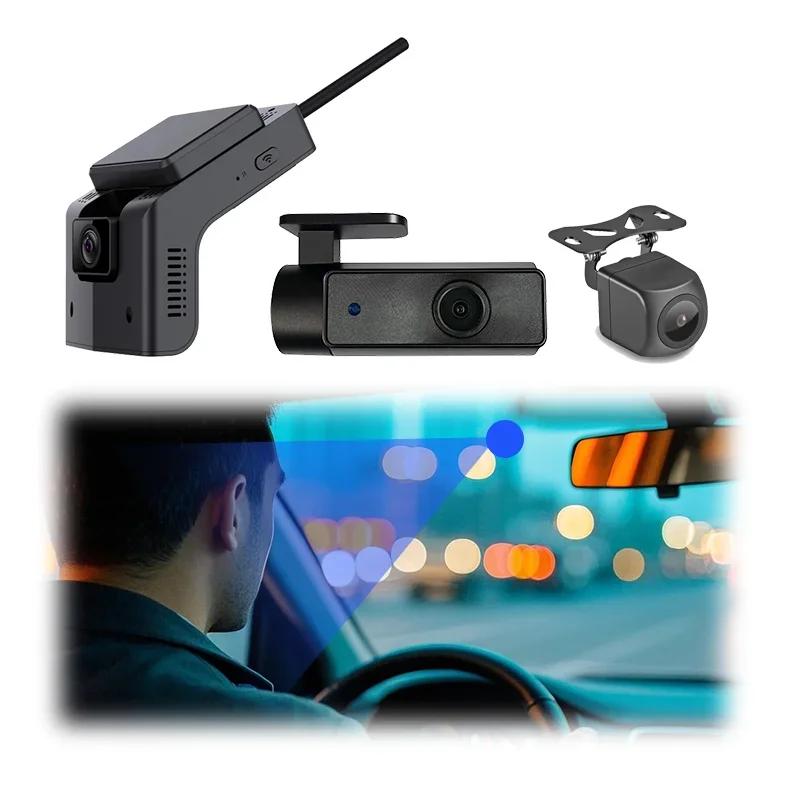
Multi-Angle Dual Dash Cam Recording for Front and In-Cab Monitoring
A standout feature is the system’s ability to provide dual dash cam coverage—front view + interior cabin recording. This dual-lens configuration is essential for ride-share drivers, school transport, logistics fleets, and corporate service vehicles.
The interior camera additionally includes:
Day/night black-and-white recording for clarity
Infrared support for low-light passenger monitoring
Optional simultaneous in-cab view + DMS behavior detection
This combined monitoring setup improves accountability, supports professional driving standards, and strengthens service quality.
AI Dash Camera with DMS for Real-Time Driver Behavior Analysis
Where traditional systems record, an AI dash camera with DMS (Driver Monitoring System) actively interprets driver behavior. The integrated DMS technology detects:
Fatigue and drowsiness
Yawning or facial micro-expressions
Driver distraction
Smoking
Mobile phone usage
Driver absence
These AI algorithms help prevent accidents before they occur. By analyzing facial and posture cues, the system detects unsafe behaviors and issues instant in-cab warnings or sends alerts to fleet managers.
Importantly, the DMS operates only under certain speed conditions to ensure reliable detection and avoid false positives.
ADAS and AI Fleet Safety Algorithms to Reduce High-Risk Driving
Beyond DMS, the camera supports full ADAS (Advanced Driver Assistance System) capabilities that analyze road conditions and driving patterns. ADAS functions include:
Lane departure warnings
Forward collision prompts
Rapid acceleration and deceleration alerts
Sharp turn notifications
Impact or collision alarms
This combination of vehicle behavior analysis and real-time alerts contributes to a predictive safety model—helping fleets identify risky drivers, schedule targeted training, and reduce operational liabilities.
GPS and 4G Tracking for Real-Time Route Monitoring
Built-in GPS and satellite positioning enhance fleet route management through:
Instant vehicle location updates
Historical route playback
Speed tracking and event timestamps
The data is crucial for route optimization, proof of service, and dispute resolution. Fleets gain deeper insight into daily operations, enabling improved dispatch planning and more efficient delivery performance.
256GB Edge Storage for High-Volume Recording
The system supports up to 256GB of onboard storage, essential for multi-channel HD recording. Large-capacity storage means:
Longer recording cycles
Extended retention of critical moments
Reliable backup when network signal is weak
This storage capacity ensures that even during extended trips or remote-area travel, the entire video timeline remains accessible.
Intelligent Emergency Response and Remote Command Tools
The system is not only a monitoring device—it is an integrated fleet command assistant. Remote access capabilities allow operators to:
Issue TTS driver reminders
Check real-time video during emergencies
Review historical footage instantly
Activate voice intercom for two-way communication
Validate incidents without waiting for manual reports
This streamlines incident handling, reduces downtime, and supports rapid decision-making in time-sensitive situations.
4 Channel Dash Cam with Superior Night Vision
High-quality night vision is crucial for urban taxis, ride-share drivers, and long-distance fleets. The super night vision function captures:
Clear cabin visibility in low light
Legible license plates
Road details in dark conditions
High-contrast imagery without excessive glare
Night performance is particularly valuable for Uber or Lyft drivers who operate during late hours, offering a strong security layer for both driver and passenger.
A New Generation of Connected Dash Camera Systems
The modern 4 channel dash camera system is no longer a passive recorder. It is a complete ecosystem combining AI detection, cloud connectivity, in-cab analysis, and full environmental observation. For fleet operators and ride-share drivers, the system helps solve real-world challenges such as risk management, passenger disputes, compliance verification, and real-time operational visibility.
With Linux stability, 4G communication, DMS/ADAS analytics, and 360° visual coverage, this new generation of dash camera systems represents a shift from traditional monitoring to fully intelligent fleet governance.