

Clear records
history record
Truck MDVR OEM ODM with 4G GPS AI Dash Cam Integration
Modern fleet operations no longer evaluate mobile DVR systems as isolated recording devices. In international markets, especially logistics, public transportation, construction fleets, and cross-border trucking, procurement decisions are increasingly driven by how deeply a Truck MDVR integrates connectivity, AI perception, data accessibility, and customization flexibility. In this blog post, Shenzhen HOPE, a high performance 1080p mobile DVR manufacturing factory, will share the advantages of truck MDVR OEM/ODM with 4G GPS AI dash cam integration.
System Architecture of Truck MDVR OEM ODM Platforms
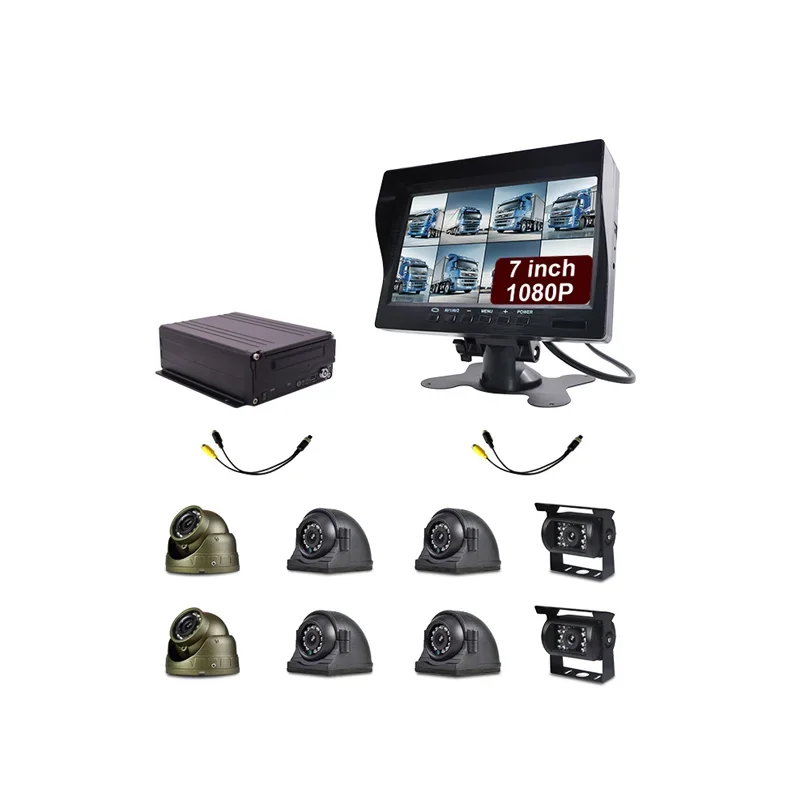
Truck MDVR OEM ODM platforms designed for global fleets typically adopt a modular architecture rather than a fixed-function design. An 8-channel mobile MDVR system with support for AHD and IP cameras allows fleet operators to configure camera topology based on vehicle type, operational risk profile, and regional regulations.
From an OEM/ODM perspective, channel scalability is essential. Heavy trucks, buses, and hazardous material vehicles often require front, rear, side, cabin, and cargo cameras simultaneously. A modular MDVR architecture ensures that adding channels does not degrade video stability, encoding efficiency, or network performance.
Equally important is hardware-level integration with a 7-inch in-vehicle monitor, enabling real-time driver feedback without reliance on external displays. For OEM customers, screen size, brightness, interface layout, and mounting structure are frequently customized to align with vehicle interiors and driver ergonomics.
4G GPS Integration for Continuous Fleet Visibility
In overseas fleet environments, inconsistent network coverage is a practical reality. A Truck MDVR OEM ODM solution with 4G GPS integration must therefore support adaptive data transmission rather than constant streaming.
Adaptive sparse GPS algorithms are widely adopted to balance tracking accuracy with bandwidth efficiency. Instead of uploading redundant location data, the system prioritizes route changes, abnormal stops, and event-triggered uploads. Offline data buffering with delayed synchronization ensures that no trajectory data is lost when vehicles operate in remote areas.
From a fleet management standpoint, integrated GPS tracking supports not only real-time monitoring but also historical route reconstruction, driving behavior analysis, and compliance auditing. For OEM/ODM buyers, the ability to customize upload frequency, coordinate precision, and reporting logic is often a decisive factor in system selection.
AI Dash Cam Integration Beyond Basic Recording
AI dash cam integration within Truck MDVR OEM ODM systems extends functionality far beyond video capture. Modern MDVR platforms embed AI algorithms directly at the edge, enabling real-time perception and decision-making without reliance on cloud latency.
Driver Monitoring Systems detect fatigue, distraction, phone usage, and abnormal head posture through cabin-facing cameras. These AI-driven insights generate immediate warnings while simultaneously triggering event recording and data uploads for post-analysis.
Advanced Driver Assistance Systems focus on forward-facing road perception. Lane departure warnings, forward collision alerts, and unsafe following distance detection are integrated directly into the MDVR processing pipeline. For fleet operators, this dual-layer AI architecture addresses both driver behavior and external risk factors.
OEM/ODM customization plays a critical role here. Different markets impose different thresholds for warnings, alert frequencies, and AI sensitivity. A configurable AI framework allows customers to fine-tune algorithms according to local regulations, insurance requirements, and operational realities.
BSD Algorithm Integration for Blind Spot Risk Control
Blind Spot Detection algorithms represent a critical safety enhancement for large commercial vehicles. Integrated BSD within Truck MDVR OEM ODM platforms enables real-time detection of pedestrians, cyclists, and vehicles at the front, side, and rear blind zones.
Unlike standalone radar-based systems, camera-driven BSD algorithms leverage visual data to classify objects and assess movement trajectories. This approach reduces false positives in urban environments and provides visual evidence for incident analysis.
From an engineering standpoint, BSD performance depends heavily on camera placement, lens angle, and image processing latency. OEM/ODM solutions therefore often include customized camera housings, IP68 waterproof ratings, and vibration-resistant wiring harnesses to ensure algorithm stability in harsh operating conditions.
Multi-Network Communication for Global Fleet Deployment
International fleet deployments require flexibility in communication protocols. Truck MDVR OEM ODM platforms supporting 3G, 4G, WiFi, and GPS offer redundancy that ensures operational continuity across regions.
WiFi connectivity is typically leveraged for depot-based data offloading, firmware updates, and high-volume video uploads. Cellular networks handle real-time alerts, live streaming, and GPS reporting during vehicle operation. The ability to seamlessly switch between networks without manual intervention is a key differentiator in mature MDVR systems.
For OEM customers, SIM configuration, carrier compatibility, and antenna customization are often critical. Supporting multiple frequency bands and regional telecom standards allows a single MDVR hardware platform to serve global markets without redesign.
Remote Monitoring Across iOS, Android, and Windows Clients
Fleet monitoring software must align with how operators actually work. Truck MDVR OEM ODM systems supporting iOS, Android, and Windows clients enable dispatchers, safety managers, and supervisors to access data from different environments without compatibility barriers.
Real-time video access, event playback, GPS visualization, and alarm notifications must remain consistent across platforms. From an OEM/ODM standpoint, UI localization, feature prioritization, and role-based access control are frequently customized to match customer workflows.
The emphasis is not on visual design but on operational efficiency. Fast loading times, stable streaming, and intuitive navigation directly influence system adoption at scale.
API Integration and Platform Interoperability
Enterprise fleet operators rarely rely on a single software system. Truck MDVR OEM ODM platforms that expose open API interfaces enable seamless integration with existing fleet management systems, ERP platforms, and third-party analytics tools.
API access allows customers to pull alarm data, GPS trajectories, video metadata, and system logs into their own dashboards. This interoperability eliminates data silos and supports centralized decision-making across large vehicle networks.
For OEM/ODM projects, API scope, documentation quality, and permission control are often negotiated early in the cooperation process. A well-structured API framework significantly increases customer retention by embedding the MDVR system into the client’s digital ecosystem.
Intelligent Data Upload and Remote Analytics
Automatic data upload is a defining feature of scalable Truck MDVR OEM ODM solutions. Instead of manual retrieval, the system categorizes and uploads alarm recordings, event snapshots, GPS logs, and operational data according to predefined rules.
Remote analytics platforms process this data to identify high-risk drivers, recurring route hazards, and compliance deviations. Over time, aggregated insights support predictive maintenance, insurance optimization, and safety policy refinement.
OEM/ODM customization often extends to data retention policies, upload triggers, and analytics granularity. These parameters directly affect operational costs and regulatory compliance, especially in regions with strict data governance requirements.
OEM ODM Customization Across Hardware and Algorithms
Customization is not limited to branding. Truck MDVR OEM ODM projects frequently involve deep customization across screens, cameras, wiring, and AI logic. Camera resolution, night vision performance, waterproof ratings, and connector types are adapted to vehicle environments and climate conditions.
AI algorithms are also tailored. Alert thresholds, recognition categories, and reporting logic are adjusted to align with customer risk models and regional standards. White-label branding, firmware UI customization, and packaging design further enable customers to position the MDVR system as a proprietary fleet solution.
This level of customization transforms the MDVR from a generic product into a core operational asset.
Strategic Value of Integrated Truck MDVR OEM ODM Solutions
Truck MDVR OEM ODM with 4G GPS AI dash cam integration is no longer about compliance alone. It directly influences safety outcomes, operational transparency, and data-driven decision-making across fleet lifecycles.
For overseas buyers, selecting an OEM/ODM partner capable of delivering integrated hardware, AI intelligence, network adaptability, and platform interoperability is a strategic investment. The long-term value lies not in isolated features but in how seamlessly these components operate together under real-world conditions.
A well-engineered MDVR system becomes an extension of fleet intelligence rather than a passive recording device.